

Bowls Codes
Introduction
One of the most interesting statistics that this site's tracking software has brought to light is that visitors have come from over 140 countries (May 2013). The majority of visitors were from bowls-playing countries and most will have arrived via a link or search engine, but the remainder will probably have found the site out of curiosity or by mistake. To many, bowls will probably be totally unknown, or at best poorly understood. So, in the hope that such visitors in the future will alight on this page and learn a little about our game and its various versions, and for anyone else who's interested, I've put together some brief notes and links on codes of bowls played in England; if I've omitted any please .
Don't overlook the laws of these codes under 'Laws and Rules' (horizontal menu above).
Flat green bowls
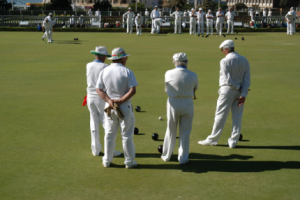
Bowling greens for flat green bowls are normally square, but may be rectangular, up to 40 m in length and surrounded by a ditch and bank. Although usually of grass, some greens are made from synthetic material. The advantage of a square green is that play can, in effect, be rotated through 90 degrees, taking place during part of the week from say north to south and in the rest of the week from east to west - thereby ensuring that wear on the same area of green is minimised. Greens are divided into rinks (parallel rectangular playing sections) and defined on the bank by vertical markers with the centre of each rink identified with a number also placed on the bank. Here's a link to a page from my other site that gives brief details of how the game is played and within it there's a link to a useful guide on buying bowls.
Crown green bowls
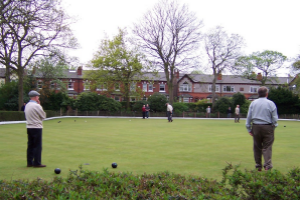
Among the more obvious differences to flat green bowls are: the playing surface slopes upwards to a roughly central 'crown' about 9 inches (230 cm) to 15 inches (380 cm) above the green's periphery; the jack is larger and biased; the 'mat' is small and circular and known as a 'footer'; games are nearly always played as singles with each player bowling two woods at each end; an end can be played in virtually any direction and several games can take place simultaneously. If you would like to know more about the game Slave to the Crown is a very informative and entertaining article. The British Crown Green Bowling Association (BCGBA) is the national governing body for the sport and provides this detailed explanation of the key differences between the crown and flat green games, and a glossary of crown green terms.
Indoor bowls
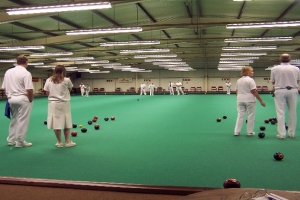 Many flat green, crown green and federation bowlers turn to indoor bowls when the English outdoor season finishes in late September or early October.
There are about 330 clubs affiliated to the English Indoor Bowling Association and the laws governing the game are very similar to those of the flat green code. The surface is carpet-like and laid on a level surface prepared to very small tolerances so that bowls run truer and faster than on the majority of outdoor greens.
Federation bowls
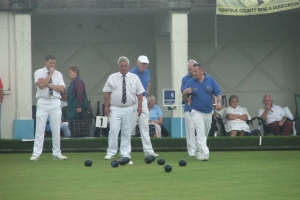 Federation bowls appears to be little known outside those areas of England in which it is played, namely East Anglia, the North-east and parts of the Midlands. To a spectator,the game appears very similar to that of flat green bowls.
The game is played on a flat green with ditch and bank, but differs from flat green bowls in a number of ways. For example, there are no touchers, only bowls within two metres of the jack can be counted for shots, and players may alter the order in which they play after each completed end. The national governing body for the sport is the English Bowling Federation.
Short mat bowls
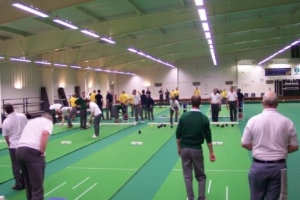 Short mat bowls is played throughout the British Isles and is a game that can be played almost anywhere indoors provided the surface is reasonably flat and level and large enough to accommodate one or more short mat carpets.
Village halls, scout huts, and sports and community centres are all popular venues. The portable carpets usually have a foam backing, are rolled out in seconds and easily rolled back after use. Fenders made of wood are placed at each end of the carpet and a piece of timber, known as the 'block' that must be avoided in play, is positioned in the centre of the carpet. Click here to see how the game is played in pictures and video. The national governing body for the sport is the English Short Mat Bowls Association.
Carpet bowls
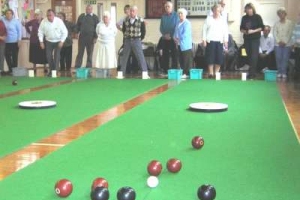 Carpet bowls is played in similar venues to short mat bowls and on portable carpets that are much the same width but shorter.
The bowls used are smaller than in any of the other codes described and, unlike the short mat code, bowls are delivered with the bowler standing off the carpet. Note also the absence of fenders. Carpet bowls also uses a block placed in the centre of the carpet that must be avoided in play, but its shape, unlike in short mat where only one shape is defined in the laws, 'may be circular, a spar, a diamond or similar'. The national governing body is the English Carpet Bowls Association and this link provides a video of how the game is played and its benefits.
Long mat bowls - a plea
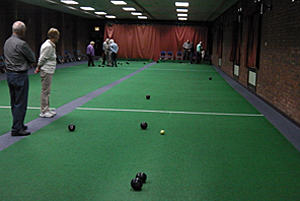 The game is played in halls which are sufficiently large to accommodate mats that are about twice the length of those used in the short mat version and wider. As in the latter code, standard crown or flat green bowls are used, as are fenders, but no block. Markings on the mat include minimum (see photo) and maximum jack lengths.
If you can provide details of the rules I'd be most grateful.
Forthcoming Titles l Videos l DVDs l Latest Additions l Feedback Form l Acknowledgements l

